UAE SME Digital Presence Checklist: 15 Things to Do Before 2027
UAE SME Digital Presence Checklist: 15 Things to Do Before 2027
Introduction
Prepare your UAE SME for 2027 with this digital checklist covering e-invoicing, privacy, website security, local SEO, social media, payments, and cybersecurity.
Updated: 19 October 2026
Running a small business in the UAE today takes more than a good product, a trade license, and a few loyal customers. You need to be discoverable online, easy to contact, secure enough to earn people's trust, and prepared for the country's changing digital and tax requirements.
Honestly, this is where many small and medium-sized enterprises (SMEs) get stuck. They spend money on Instagram ads but forget to renew their domain. They collect customer details through WhatsApp without thinking about privacy. Or they send invoices as PDFs, assuming that digital delivery automatically means e-invoicing compliance.
It doesn't.
The UAE is moving towards more structured digital business processes, and the transition to electronic invoicing makes preparation particularly important. Meanwhile, customers search on Google, compare businesses on social media, read reviews, and expect quick responses on their phones.
The opportunity is real. According to DataReportal's Digital 2026: United Arab Emirates report, the UAE had 11.3 million internet users at the end of 2025, representing 99% internet penetration. Its analysis also recorded 12.5 million social media user identities in October 2025. These are reported accounts or identities, not necessarily unique individuals, but they still show why online visibility deserves serious attention.
So, where should your business start?
This UAE SME digital presence checklist covers the essential tasks to complete before 2027, from e-invoicing and privacy to websites, local SEO, social media, payments, cybersecurity, and analytics.
Important: This article provides general information, not legal or tax advice. UAE requirements can change, so verify time-sensitive obligations with the relevant government authority or a qualified adviser before acting.
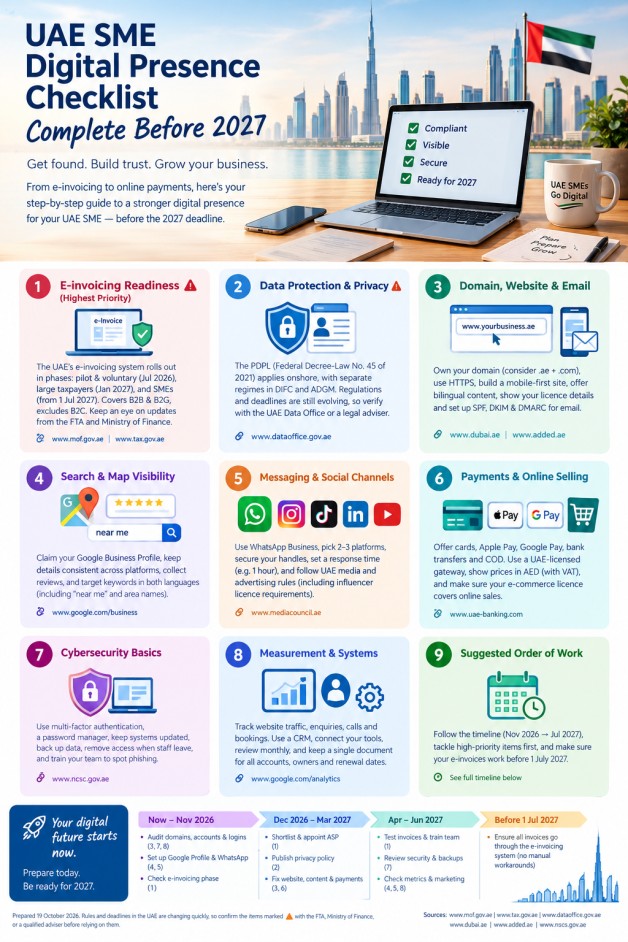
1. Prepare for UAE E-Invoicing Before the Deadline
If there's one section you shouldn't postpone, it's this one.
The UAE's electronic invoicing system is being introduced through an Accredited Service Provider (ASP) model using the international Peppol framework. Under this approach, invoice information is exchanged in a structured electronic format rather than simply being sent as a document attachment.
A PDF invoice emailed to a customer might look professional, but that doesn't automatically make it a compliant e-invoice.
The Federal Tax Authority's official e-invoicing page explains the difference between structured e-invoices and unstructured formats such as PDFs, Word files, images, and scanned documents.
What is the UAE e-invoicing timeline for SMEs?
According to the UAE Ministry of Finance's electronic invoicing guidelines, the pilot and voluntary implementation phases began on 1 July 2026.
The published mandatory implementation schedule distinguishes businesses by annual revenue.
- Businesses with annual revenue of AED 50 million or more: The original published deadline to appoint an ASP was 31 July 2026, with implementation scheduled for 1 January 2027. However, the Ministry subsequently extended the ASP appointment deadline for this group to 30 October 2026. Check the latest official notices for any further changes.
- Businesses with annual revenue below AED 50 million: Appoint an ASP by 31 March 2027 and implement the system by 1 July 2027.
- Government entities: The published implementation date is 1 October 2027, subject to the applicable rules.
The Ministry announced the large-business extension in its 10 May 2026 update. The Ministry's ASP register should be your starting point when comparing providers.
One important detail: don't assume that being below the AED 50 million threshold automatically exempts your business. Confirm whether your transactions fall within the system's scope and which requirements apply to your circumstances.
Your e-invoicing readiness checklist
☐ Confirm your annual revenue and the implementation phase that applies to your business.
☐ Ask your accounting or ERP software provider whether its system supports the UAE's required format, including PINT AE, and can connect to an accredited provider.
☐ Compare accredited ASPs using the current Ministry of Finance register. Look at integration options, support, transaction fees, and onboarding time.
☐ Confirm your ASP appointment deadline and allow enough time for testing before the mandatory go-live date.
☐ Clean your customer and supplier records, including legal names, addresses, tax registration details where applicable, and contact information.
☐ Check how credit notes, corrections, failed transmissions, and system outages will be handled.
☐ Assign one person to manage implementation and monitor compliance notifications.
Think of this like replacing the plumbing in a building while people are still using it. You don't wait until water stops flowing to find a contractor. In the same way, your business should test its invoicing workflow before the deadline, not when a customer is waiting for an invoice.
What about penalties? Administrative penalties are governed by UAE decisions and can change. Don't rely on an old blog post or a software vendor's sales presentation for the amounts. Check the latest Federal Tax Authority guidance and applicable ministerial decisions before budgeting for compliance.
2. Review Your UAE Data Protection and Privacy Practices
Your customer database is an asset. Treating it casually can turn that asset into a liability.
Think about the information your business collects every week: names, phone numbers, email addresses, website enquiries, WhatsApp conversations, payment records, employee information, and marketing preferences. You might have pieces of this information scattered across five different platforms without even realising it.
The UAE's federal Personal Data Protection Law, Federal Decree-Law No. 45 of 2021, establishes a framework for protecting personal data. The federal regime is not the only one to consider; businesses operating in the Dubai International Financial Centre (DIFC) or Abu Dhabi Global Market (ADGM) may be subject to separate data protection rules.
You can start with the UAE Government's official data protection guidance.
Your privacy checklist
☐ List the personal information you collect and identify where it is stored.
☐ Publish a clear privacy policy that explains what you collect, why you collect it, and how people can contact you about their data. Consider providing it in both English and Arabic.
☐ Review cookies, analytics, advertising pixels, and other tracking technologies on your website. Implement consent controls where required.
☐ Keep records of marketing permissions and provide a straightforward way for people to unsubscribe.
☐ Establish a process for handling requests to access, correct, or delete personal data, subject to applicable legal requirements.
☐ Prepare a simple data-breach response plan that identifies who investigates, who makes decisions, and who must be notified.
☐ Check where your cloud software stores information and whether international data transfers create additional obligations.
Don't copy a privacy policy from another website and assume you're protected. Your policy should reflect what your business actually does, and the legal requirements that apply to it.
Also, be careful with claims about deadlines and fines. If a consultant promises that a particular template makes you completely compliant, ask them to explain the legal basis and how it applies to your business.
3. Secure Your Domain, Website, and Business Email
Your website is often the first impression a potential customer gets of your company. Make it count.
Imagine arriving at a shop with a broken sign, a locked door, and no phone number outside. You probably wouldn't spend much time trying to find the owner. A website with expired security certificates, outdated contact details, or confusing navigation creates a similar experience.
Your website checklist
☐ Register your business domain, considering a .ae address alongside .com where appropriate.
☐ Make sure the company owns the domain rather than an individual employee, freelancer, or former agency.
☐ Enable automatic renewal and keep registrar access and recovery details up to date.
☐ Use HTTPS throughout the website and configure automatic SSL/TLS certificate renewal.
☐ Build and test the website for mobile users first, rather than treating the mobile layout as an afterthought.
☐ Provide English and Arabic content where relevant, with proper right-to-left formatting for Arabic pages.
☐ Display your business identity, contact information, and licence details where required by the applicable emirate, licensing authority, or free zone.
☐ Include useful service or product pages, an About page, contact information, FAQs, and clear pricing guidance where practical.
☐ Test page speed on mobile connections and compress large images without making them look blurry.
Why business email still matters
Use an address such as hello@yourcompany.ae instead of relying entirely on a free personal email account.
Then configure SPF, DKIM, and DMARC. These email authentication mechanisms help receiving mail servers assess whether messages claiming to come from your domain are legitimate. They don't guarantee inbox placement, but they can reduce certain forms of spoofing and improve your email security posture.
A website is your digital storefront; business email is the business card you hand to everyone who walks through the door. Both need to look trustworthy.
4. Improve Google Search and Local SEO Visibility
You could offer excellent service in Dubai, Sharjah, Abu Dhabi, or another UAE emirate and still lose customers because they can't find you online.
Local SEO helps your business appear when people search for the products and services you provide, particularly when their search includes a neighbourhood or phrases such as "near me."
Your local SEO checklist
☐ Claim and verify your Google Business Profile.
☐ Keep your business name, address, phone number, opening hours, and website consistent across Google, Apple Maps, Bing, Facebook, and relevant directories.
☐ Update your opening hours for Ramadan, public holidays, and other seasonal changes.
☐ Add accurate English and Arabic business descriptions, categories, service details, and recent photographs.
☐ Ask satisfied customers for honest reviews and respond professionally to positive and negative feedback.
☐ Research the search terms customers actually use in both languages, including service names and location-specific phrases.
☐ Create dedicated pages for your main services and the locations you genuinely serve.
For example, a cleaning company serving Dubai Marina shouldn't depend on a single generic homepage to explain every service. Separate pages for apartment cleaning, office cleaning, and other genuine service areas can help visitors find the information they need.
But don't create dozens of nearly identical location pages just to repeat keywords. Useful content wins over empty repetition in the long run.
Make your business easier to trust
Your Google profile, website, and social pages should tell the same story. If one displays an old phone number and another lists different opening hours, potential customers may wonder which information is correct.
Reviews matter, too. Replying to a complaint calmly and offering a practical solution shows future customers how your business behaves when something goes wrong.
5. Set Up WhatsApp Business and the Right Social Media Channels
Your customers may discover you through Google, see your work on Instagram, check your Facebook page, and finally message you on WhatsApp.
That's a normal customer journey. Your job is to make it easy.
According to DataReportal's UAE Digital 2026 report, Meta's advertising tools indicated an Instagram audience of approximately 8.05 million users in the UAE in late 2025. Its reported Facebook advertising reach was equivalent to 85% of the total population at the end of 2025. These figures describe advertising reach and platform-reported identities, not verified counts of unique active customers.
The lesson isn't that every SME must be active on every platform. It's that your channel choices should be based on where your audience spends time and how it prefers to buy.
Your social media and messaging checklist
☐ Set up WhatsApp Business with accurate business details, a catalogue where appropriate, greeting and away messages, and saved quick replies.
☐ Add a WhatsApp click-to-chat link to your website, Google profile, and relevant social media bios.
☐ Choose two or three primary platforms based on your audience and business model.
☐ Secure your preferred business username on Facebook, Instagram, TikTok, LinkedIn, and YouTube, even if you don't intend to use every account immediately.
☐ Set a realistic response-time target, such as replying to enquiries within one business hour during working hours.
☐ Use a consistent brand identity, including your logo, contact details, colours, and tone of voice.
☐ Check current UAE media, advertising, and influencer requirements before launching promotional campaigns.
For a visual business such as a bakery, salon, restaurant, or interior design company, Instagram may be a useful place to showcase finished work. A B2B consultancy might get more value from LinkedIn, detailed case studies, and professional referrals. Facebook can still be relevant for local communities, neighbourhood groups, and certain customer demographics.
And don't underestimate ordinary content. Short demonstrations, before-and-after images, customer questions, behind-the-scenes videos, and practical tips can help people understand what you offer without every post feeling like an advertisement.
Don't overlook UAE influencer advertising rules
If you pay creators to promote your business, provide products in exchange for promotional content, or collaborate on advertising, check the applicable permit and disclosure requirements.
The UAE Media Council's advertiser permit guidance is a useful starting point. Requirements can depend on the activity and the person publishing the content, so confirm the current rules before a campaign goes live.
6. Make Online Payments and E-Commerce Easier
A customer may love your product, trust your business, and reach the checkout page—then leave because the payment process is confusing.
That's a lost opportunity.
Your checkout should feel like a smooth airport check-in, not a queue where nobody knows which counter to use.
Your online payment checklist
☐ Offer suitable payment methods, such as cards, Apple Pay, Google Pay, bank transfers, or payment links, depending on your customers and provider.
☐ Choose an appropriately licensed payment provider and understand its fees, settlement times, refund processes, and chargeback procedures.
☐ Display prices in AED where appropriate and show VAT accurately when applicable.
☐ Publish understandable delivery, cancellation, return, and refund policies.
☐ Confirm that your trade licence covers the actual e-commerce activities your business conducts.
☐ Test the entire checkout journey on mobile devices.
☐ Show customers the total payable amount, including applicable taxes and delivery charges, before they confirm payment.
☐ Send clear order confirmations, receipts, and delivery updates.
For online sellers, the final price should never come as a surprise. If delivery costs appear only after a customer has entered personal details, you've introduced unnecessary friction at the most important stage of the sale.
Also, don't assume that installing a payment gateway automatically makes an online store legally compliant. Your licensing, consumer-facing terms, tax treatment, and payment arrangements all need to be considered separately.
7. Strengthen Cybersecurity Before a Small Problem Becomes a Big One
Small businesses are not too small to be targeted. Sometimes, they're attractive precisely because their security controls are weaker.
A stolen social media account can damage customer trust. A compromised business email account can expose invoices and payment instructions. And one convincing fake bank-change request can lead to money being sent to the wrong account.
Cybersecurity doesn't have to begin with an expensive enterprise system. Start with the basics and make them routine.
Your SME cybersecurity checklist
☐ Enable multi-factor authentication on email, banking, domain registrar accounts, social platforms, website administration, and accounting software.
☐ Use a password manager and give each employee their own account instead of sharing passwords through chat groups.
☐ Keep your website platform, plugins, computers, phones, and business applications updated.
☐ Back up your website and business records automatically, and periodically test whether you can restore them.
☐ Remove access promptly when employees or contractors leave.
☐ Limit administrator privileges to people who genuinely need them.
☐ Train employees to recognise phishing messages, suspicious attachments, fake invoices, and requests to change bank details.
☐ Review who can publish content, run advertisements, or access recovery settings on business social accounts.
☐ Keep an up-to-date list of important accounts, their owners, and their recovery methods.
One particularly useful rule: whenever a supplier emails new bank details, verify the change using a trusted phone number already on file. Don't simply reply to the same email or trust a new number supplied in the message.
It takes an extra minute. It may save you a great deal more.
8. Connect Your Systems and Measure What Actually Works
You don't need a complicated technology stack to run a data-informed SME. You need to know where enquiries come from, which ones turn into sales, and where potential customers drop out.
Think of your analytics as a car's dashboard. You can keep driving without looking at it, but you won't know how fast you're going, how much fuel remains, or whether something needs attention.
Your measurement checklist
☐ Install suitable website analytics and configure privacy and consent controls as required.
☐ Track meaningful actions such as enquiry submissions, phone calls, WhatsApp clicks, bookings, and purchases.
☐ Use a simple customer relationship management (CRM) system to record leads, follow-ups, and sales outcomes.
☐ Connect accounting, invoicing, and sales tools where practical to reduce duplicate data entry.
☐ Review website traffic, enquiries, conversion rates, customer reviews, and response times every month.
☐ Maintain a central register of business accounts, account owners, renewal dates, and recurring costs.
☐ Set a small number of measurable marketing goals for each quarter.
For example, don't just report that your website received 5,000 visits. Ask how many visitors contacted you, how many became qualified leads, and how many eventually purchased something.
And remember, more traffic isn't always better. A smaller number of visitors who genuinely need your service can be worth much more than thousands of people who leave without taking action.
9. Follow This UAE SME Digital Readiness Timeline
Trying to fix everything at once can be overwhelming, especially when you're managing customers, staff, suppliers, and daily operations.
The answer is to prioritise the tasks that carry the greatest compliance or financial risk, then work through the improvements that make your business easier to find and buy from.
October to November 2026: Audit and prioritise
☐ Review your domain ownership, renewals, account access, passwords, and security settings.
☐ Claim your Google Business Profile and set up or improve WhatsApp Business.
☐ Check your annual revenue and confirm your e-invoicing phase.
☐ If your annual revenue is AED 50 million or more, urgently verify your ASP appointment deadline, particularly the published 30 October 2026 extension.
☐ Ask your accounting software provider about compatibility, integrations, and implementation costs.
☐ Review the privacy information and customer data your business collects.
December 2026 to March 2027: Build and integrate
☐ If you're in the below-AED-50-million group, shortlist providers and appoint an ASP by 31 March 2027, subject to any subsequent official changes.
☐ Clean customer and supplier records and prepare your invoicing workflows.
☐ Publish or update your privacy policy and implement appropriate consent controls.
☐ Improve website speed, bilingual content, business email authentication, and mobile usability.
☐ Review your payment process, pricing presentation, and e-commerce licence requirements.
☐ Strengthen your Google profile, social media presence, and lead-tracking process.
April to June 2027: Test and train
☐ Run test invoices through your selected provider and resolve integration problems.
☐ Train the staff who will issue invoices, manage credit notes, and handle errors.
☐ Review website backups, account permissions, and security procedures.
☐ Check your marketing performance and improve the channels that generate qualified enquiries.
☐ Confirm that your systems can handle your normal invoicing volume without relying on manual workarounds.
Before 1 July 2027: Confirm readiness
☐ Recheck the latest official requirements and your implementation date.
☐ Confirm that the required systems, provider connections, and business records are ready.
☐ Test the complete invoice workflow and establish a process for monitoring failures.
☐ Keep records of your implementation, staff training, and relevant compliance decisions.
Don't leave testing until the final week. A system that works for one invoice may still fail when you introduce credit notes, customer-data errors, or multiple transactions.
10. Common Digital Mistakes UAE SMEs Should Avoid
Even businesses that have websites and social media accounts can have significant gaps in their digital setup.
Here are five mistakes worth checking before the end of 2026.
Mistake 1: Treating a PDF as a compliant e-invoice. The UAE's structured electronic invoicing system requires more than emailing an invoice attachment. Confirm your obligations and software compatibility.
Mistake 2: Treating social media followers as business results. Followers and likes may indicate interest, but qualified enquiries, completed sales, repeat purchases, and customer retention tell you more about commercial performance.
Mistake 3: Depending on one employee or agency for every account. Your business should retain ownership of its domain, website, advertising accounts, social profiles, and essential recovery details.
Mistake 4: Copying legal documents from another company. A privacy policy, refund policy, or website disclaimer should reflect your own activities and the rules applicable to your business.
Mistake 5: Spending on advertising before fixing the customer journey. More visitors won't solve a broken checkout, a slow mobile website, missing contact information, or unanswered WhatsApp messages.
The common thread? Digital presence isn't just about being visible. It's about making the whole experience work, from the first search to the final payment.
Frequently Asked Questions
What should UAE SMEs prioritise before 2027?
Start with compliance and operational risks: confirm your e-invoicing obligations, review privacy practices, secure business accounts, and check domain ownership. Then improve local search visibility, WhatsApp Business, website performance, payment flows, and lead tracking.
When does mandatory e-invoicing start for UAE SMEs?
Under the published phased schedule, businesses with annual revenue below AED 50 million must appoint an ASP by 31 March 2027 and implement the system by 1 July 2027. Businesses with annual revenue of AED 50 million or more have a separate schedule, with the ASP appointment deadline extended to 30 October 2026 in the Ministry's May 2026 announcement. Confirm the latest official position before relying on these dates.
Does a small UAE business need a website if it already uses Instagram?
A website is not automatically necessary for every business model, but it gives you greater control over your information, service pages, enquiries, search visibility, and customer journey. Social media can complement your website rather than replace every function it provides.
Which social media platforms should UAE SMEs use?
Choose platforms based on your customers and objectives. Instagram and TikTok can suit visual content, LinkedIn can be useful for B2B services, and Facebook may help businesses reach local communities. WhatsApp Business is particularly useful for direct customer communication, but the right combination depends on your business.
Do UAE SMEs need a privacy policy?
A privacy policy is a sensible starting point for explaining how your business collects and uses personal information. Your specific legal obligations depend on the applicable data protection regime and your activities, so review the relevant rules rather than relying on a generic template.
How much should a UAE SME spend on digital marketing?
There is no single budget that suits every business. Start with your goals, customer acquisition costs, available resources, and the channels that generate qualified leads. Measure results regularly and increase spending only when you have evidence that a channel is contributing to your business objectives.
Final Thoughts: Make Your Digital Presence Work for You
Preparing for 2027 doesn't mean buying every new software tool or posting on every social platform. It means building a business that customers can find, trust, contact, and pay without unnecessary friction.
Start with your legal and financial responsibilities. Secure your digital assets. Make your website useful on mobile. Respond to enquiries promptly, and measure the results instead of guessing.
You don't have to finish every task in a single week. But you do need a plan, clear ownership, and realistic deadlines.
Your next step: Choose the three highest-priority items from this checklist, assign someone to each, and set a completion date. Then keep moving down the list.
A stronger digital presence isn't built in one dramatic launch. It's built through small improvements that keep working long after the launch announcement is forgotten.
Official Sources and Further Reading
Use these resources to verify requirements and keep your business checklist current.
- UAE Ministry of Finance — E-invoicing Accredited Service Providers:https://mof.gov.ae/en/about-us/initiatives/einvoicing/einvoicing-accredited-service-providers-asps/
- UAE Ministry of Finance — Electronic Invoicing Guidelines (PDF):https://mof.gov.ae/wp-content/uploads/2026/06/UAE-Electronic-Invoicing-Guidelines_V-1.1-01June2026.pdf
- Federal Tax Authority — UAE E-Invoicing:https://tax.gov.ae/en/content/uae.einvoicing.aspx
- UAE Government — Data Protection Laws:https://u.ae/en/about-the-uae/digital-uae/data/data-protection-laws.
- UAE Media Council — Advertiser Permit:https://uaemc.gov.ae/en/media-services/a-permit-for-a-natural-person-to-provide-advertising-or-media-content-in-social-media-and-other-modern-technical-means-individuals/
- Google Business Profile:https://www.google.com/business/
- DataReportal — Digital 2026: United Arab Emirates:https://datareportal.com/reports/digital-2026-united-arab-emirates
- WhatsApp Business:https://business.whatsapp.com/
This checklist is general informational guidance, not legal, tax, cybersecurity, or professional compliance advice. Confirm applicable requirements with the relevant UAE authority or a qualified adviser before making decisions.